Tag Archives: B2C

Personally I think its Personalisation!

Personalisation

I was recently invited to speak at one of the Innovation Enterprise summits in London (IE run some excellent global events that attract CxO level attendees from a spectrum of businesses areas). Although this event was focused primarily on content, I was giving the final talk of the day and chose to concentrate on personalisation.

I opened with the above diagram and although all the images relate to recent experiences of mine, they all ultimately describe the need to know me as a person, and the importance of delivering a digital engagement that is targeted to me…that is me! Not a persona or machine generated impression of me, but me!

Why does this matter? In my opinion because I believe this is key to the digital future of all companies. We know of the generic user journeys we’ve no doubt all mapped, and the personas we’ve all created. But they are still very generic.

Marketing Week - Reaching e-commerce consumers in the 12-minute window

Marketing Week – Reaching e-commerce consumers in the 12-minute window

With ever shortening attention spans and social channels becoming clogged with information, ads or updates, getting the message across is becoming increasingly harder.

However, something targeted to me in my favourite colour (seriously) or on my preferred channel, or more importantly that knows where I am in the purchase journey and targets the information I need at this stage, will get me interested and engaged. The rest drop in to my conscious but dis-engaged delete marathon that I run almost daily on my spam email address (you know the one you use to register for white papers and so on).

In summary to get ahead you first need to get to know!


Which digital channel is right for me? #toomanychannels

Sometime back, before I had created the digital strategy for my business and started its digital transformation journey, this question perplexed me. And I mean, really perplexed me! Which are the right digital channels to engage with? confused

Which, of all the digital channels should I use? Which one will guarantee me success? Facebook is on the wane should I therefore ignore it? LinkedIn is for business will I alienate people if I use it. What does a B2B need v a B2C? Is Twitter of any value…and so on.

Of course, the answer is all of them! They are all relevant and important channels to ensure the successful implementation of your digital strategy and transformation. So don’t waste too much time deliberating which one matters to you, but instead think about which one(s) you might want to start with.

To help with this, some considerations you may want to take into account

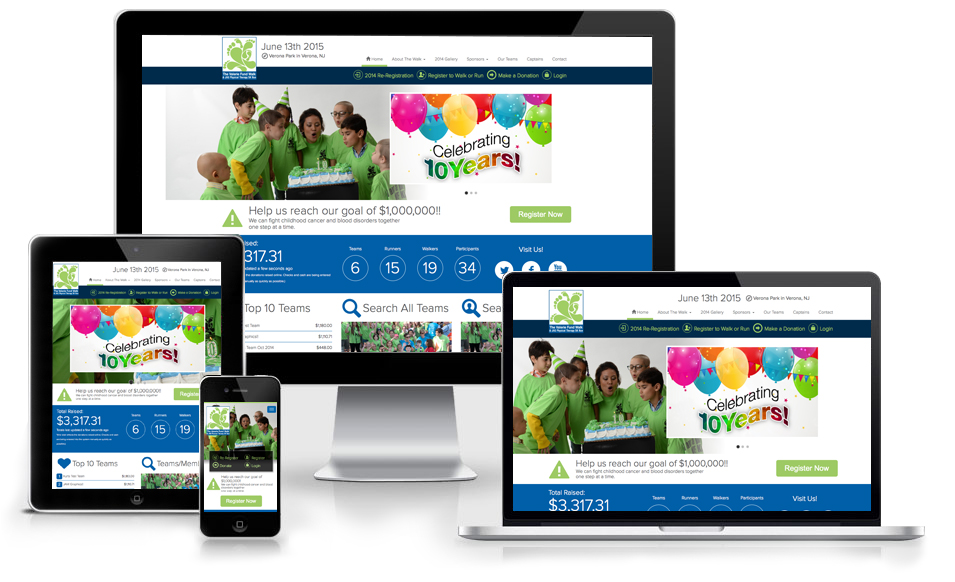
  1. Do you have a strong web site, mobile friendly, engaging etc.? Ultimately you’re going to want all move your customers to an action, and this will be either interacting with content or hopefully buying something. And that is likely to be on your website. So if your tweets or blogs are awesome, but your website is as engaging as a magnolia painted brick, you’re going to have problems. Sort out your website first!
    website
  2. What country are your audience in, and how does your target audience in these countries leverage and engage with the various digital channels today? This is a key consideration. Brasil for example are big on Social Media for B2C and B2B engagement. China have Weibo and don’t allow Youtube etc. So if Brazil is your target country and you were planning on using LinkedIn, you’re strategy may fail purely based on using the wrong channel. Identify your audience, where they are and what they use today.Digital snapshot
  3. What kind of content do you have/can you generate and how frequently? In this sound-bite consumption world, not all hooks catch a fish. So having frequent and different content types across the channels maximizes your chance of catching a prospective customer. Develop a content strategy, keep it simple and build in a resource plan to keep it current!(image source: http://www.garyhyman.com)contentwritingblog
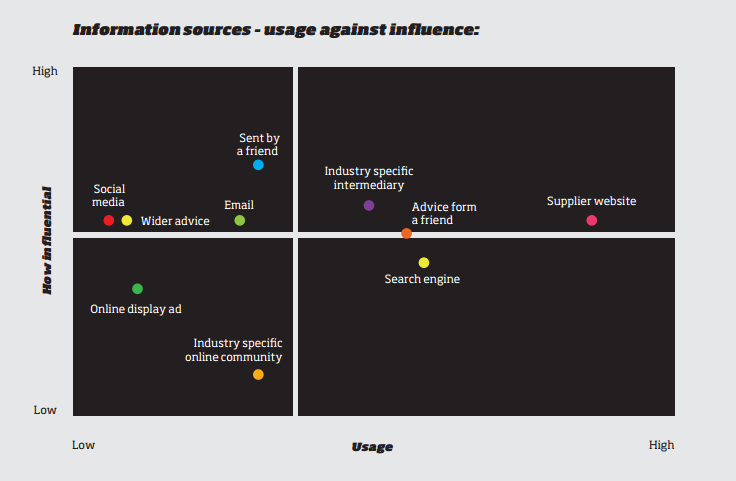
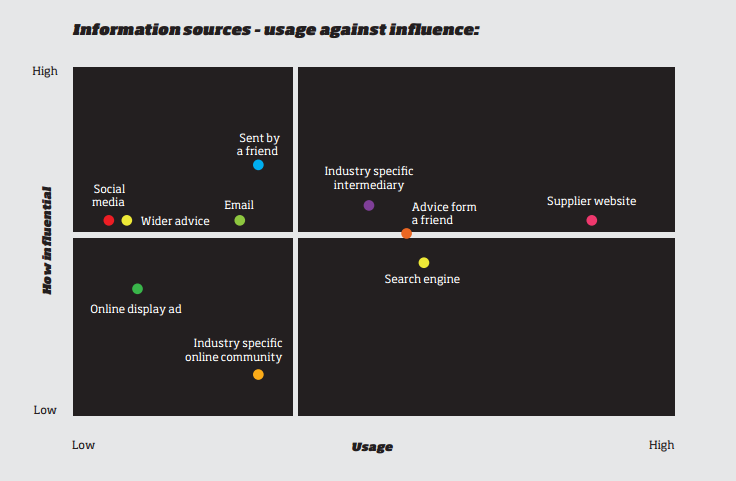
  4. Can you rank the digital channels by probabilities of successful engagement? Roll out your strategy on 1-2 channels first, gauge the customer engagement, and the commitment from your side to keep the content flowing, and then add in others as your experience and ability mature. My suggestion would be not to start with your highest ranked probability of success, but to start light and less obviously  (image source: http://www.smartinsights.com)Buyersphereb2breport2015influencevsusage
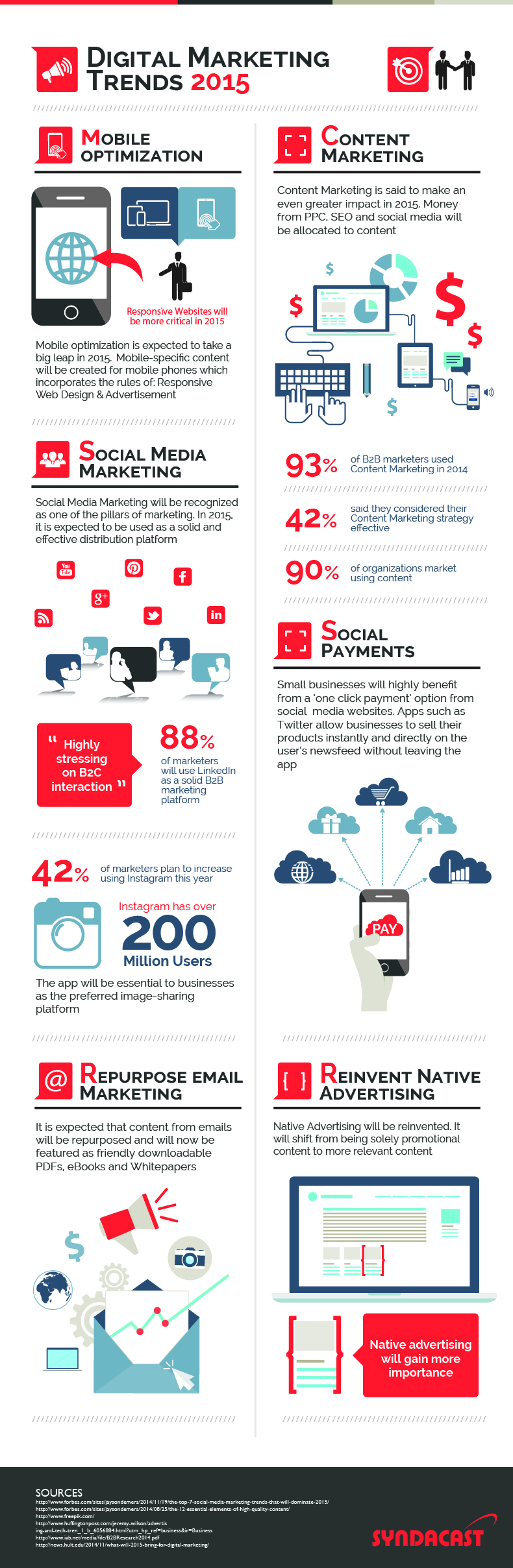
  5. Finally, are you aware of current and future trends? We have some very established social channels now, but new ones appear almost daily and you need to either corner the market on them for your brand immediately or keep close tabs to see how/if they blossom. Either way, you should have a cookie cutter approach to adopting new digital channels, such that you can swiftly execute an adoption plan.

2015-digital-marketing-trends--what-opportunities-lie-ahead_54978e613f9cd

I hope you found this of some use.

Catch you all soon.


Announcing THE 2015 B2B Marketing prediction!

DEACM

I love this time of year, along with the parties, presents, general cheer and happiness there is also the liberal giving of opinions, thoughts, guesstimations and general predictions for the forthcoming year, and marketing, like many other disciplines, participates in this with gusto.

So without wanting to feel left-out or robbing the general public of my own crystal ball like vision, I’ve decided to post a short article on what I sincerely believe is the future of B2B marketing certainly for 2015 and probably into 2016.

We’ve had over the last few years social media, mobile and content marketing, outbound to inbound, SEO and SEM to name but a few, as a focus for marketing departments, and with this have seen a general maturing of both companies and customers in the use and expectations of the various digital marketing platforms.

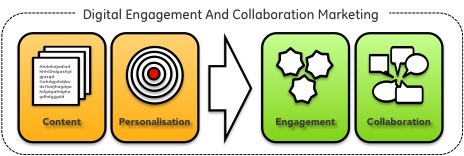
What I now see as departments and people ripen in their grasp of digital marketing, is an inevitable and logical move to Digital Engagement And Collaboration Marketing (DEACM) in 2015. As companies come to terms with content marketing and understand that long-winded highly technical documents tend to only be appreciated by the author, or that ‘matey’ banter only works at your local watering hole and very rarely on-line in a B2B, there will be a general acceptance that the purpose of good content is to engage your target audience, and that your target audience is expecting good content. Once engaged though, what happens next?

The B2C generalised expectation is that you will by the item you came to the site for, However in a B2B, that is often not the case. With longer cycle purchase journeys and products that can be too costly to purchase online, there is a need to build on the engaged content, to maintain the relationship with the customer. This is the key value of DEACM…Collaboration! I believe we will see probably toward the end of 2015 a drive to encourage customers to collaborate around the content, discuss it’s merits, share examples, challenge and even disagree. I believe the openness of companies to encourage candid discussions and feedback, suggestions and comments will significantly and positively impact growth as customers move from sceptics to loyal brand ambassadors. A transition built on the development of trust between vendor and customer, and built from great content that encourages engagement and collaboration.

I suspect this doesn’t sound like rocket science to anyone, and it isn’t. However, in the B2B space, a segment that significantly lags behind its B2C sibling, it is. It has been a forced march for digital marketing in B2B’s over the last 18 months, with very steep learning curves. This has had pro’s and con’s, the cons – B2B’s are not delivering digital engagements their customers expect, the pros – they can take advantage of all the good work other digital marketing teams have done and learn how to adapt them for what is a very different and sceptical user community, that of the business buyer.

This is something I strongly believe in and will provide an update to this article in April as I deliver on this exact topic.

That’s enough from my crystal ball gazing, I want to take this opportunity to wish you all a wonderful Christmas /Holiday break and a Happy New Year.

Crystal-Ball

DEACM, you heard it here first!


Don’t look for what isn’t there. You won’t find it!

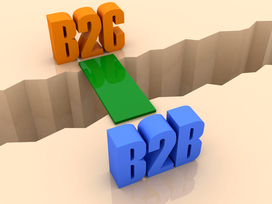
B2B v B2C

B2B v B2C

So, my team and I are merrily rocking along the road to implementing our digital transformation strategy…swatting aside the ney-sayers, pessimists, doubters and layers of bureaucracy, with the full knowledge that my digital strategy is the only suitable strategy for the business.

However, there is one thing that puzzles me, and simply put it is whether there is any difference between a B2C and B2B purchaser. The reason I really want to understand this is because I don’t just want the strategy to work for now, but to adapt and work in 2, 3 and 4 years from now. To ensure this I feel I really need to understand whether I’m articulating a strategy for a specific B2B target, or whether in the very near future there really will just be a person with money to buy something and the channels used, experience expected and content consumed will be the same!

Why does this matter? Well I feel that if there really is a B2B buyer and their behaviour and approach to digital channels is different from that of you and I as a general consumer, then I need to ensure I’m continually feeling for that engagement. Staying abreast of the channels used and even the type of content required. However, if there is more of a merge of the two and a creation of a B2P (Business To Person), then I really need to just follow the latest trends in digital channels and adoption, “videos are in…then lets do videos!”. I like easy, and the latter sounds easier!

My personal belief is that we’re already moving to the B2P world. I really felt mid last year that the B2B consumer suddenly became more like a B2C one, leveraging and trusting more and more content online, and engaging the different and new digital channels as they did so. Will it stay that way. Is the type of product being marketed online going to be the only differentiator between a B2B and a B2C?